

ACNE SURGERY This modality, used for the removal of comedones and superficial pustules, aids in bringing about involution of individual acne lesions. Acne surgery was a mainstay of therapy in the past. However, with the advent of comedolytic agents such as topical vitamin A acid, it is not needed as often. Its use is primarily restricted to those patients who do not respond to comedolytic agents. Even in those patients, the comedones are removed with greater ease and less trauma if the patient is treated first with topical vitamin A acid or a similar topical agent for 3 to 4 weeks. This pretreatment should be done in all patients who are going to undergo mechanical comedo removal. Acne surgery is helpful only when properly done, and inaccurate placement of the comedo extractor may serve only to push the inflammatory material further into the skin. Therefore, it is inadvisable to have the patient do acne surgery at home. The Unna type of comedo extractor, which has a broad flat plate and no narrow sharp edges, is preferable. The removal of open comedones does not materially influence the course of the disease because these lesions do not become inflammatory. However, it is desirable to remove them for cosmetic purposes. In contrast, closed comedones should be removed to prevent their rupture. Unfortunately, the orifice of closed comedones is often very small, and usually the material contained within the comedo can be removed only after the orifice is gently enlarged with a no. 25 needle or other suitable sharply pointed instrument.
INTRALESIONAL GLUCOCORTICOIDS Intralesional injection of glucocorticoids, either by the use of a syringe or by the use of an automatic needleless injector, usually dramatically decreases the size of deep nodular lesions. The injection of 0.05 to 0.25 mL per lesion of a triamcinolone acetate suspension (2.5 to 10 mg/mL) is recommended as the anti-inflammatory agent. This is a very useful form of therapy in the patient with nodular acne, but it often has to be repeated every 2 to 3 weeks. A major advantage is that it can be done without incising or draining the lesions, thus avoiding the possibility of scar formation.
Acne on back and the appearance industry
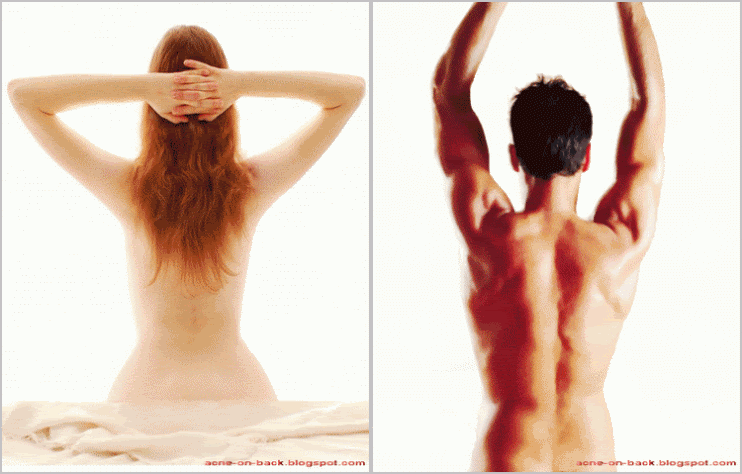 Being preoccupied with appearance, the acne on back sufferer usually have a negative self image, and may develop psychological problems.
Because the color, texture, and appearance of the skin, are important physical factors contributing to outer beauty; and when many people are more concerned with physical beauty, though inner beauty is more pleasing to the mind, real beauty would cease to matter. Needless to say that, it is not a person’s skin that makes them attractive but a combination of all the unique characteristics that they are.
The media, and television in particular, actively promote levels of attractiveness related to appearance and particular physical properties. Attractiveness has thus shaped people attitudes in favor of physical beauty in many life aspects, such as employment, social opportunities, friendship, s*xual behavior, and marriage. The media transmit messages concerning physical beauty, perfection and disfigurement, and usually offer suggestions and practical advice as to how the influence of these aspects can be reduced or altered. As they are promoting certain products, they are creating markets for advertisers at the same time. the media have propagated the idea that perfection is a normal thing in society and that those who are unattractive can easily gain this supposedly ‘normal’ appearance.
The concept of body image defined as our perception of the way that others see us, is therefore affected by any physical changes to the way that we look.
As acne develops in adolescence, a time when people are generally most sensitive about their appearance; symptoms such as depression or social anxiety reflect their real concern over body image.
The costs of treatment may also complicate the problem and can cause great distress.
The visibility of acne on back may attract attention in certain social situations, thus making the individual feel that they can’t keep their condition private or personal.The sufferer may find that some people react negatively towards them or treat them differently because of the way that they look.
Negative misconceptions about acne are still there; some people still think it is associated with a person’s inability to ‘properly take care of themselves or a lack of cleanliness and reactions to this can range from curiosity to rejection therefore, acne sufferers become socially withdrawn...to be continued.
Being preoccupied with appearance, the acne on back sufferer usually have a negative self image, and may develop psychological problems.
Because the color, texture, and appearance of the skin, are important physical factors contributing to outer beauty; and when many people are more concerned with physical beauty, though inner beauty is more pleasing to the mind, real beauty would cease to matter. Needless to say that, it is not a person’s skin that makes them attractive but a combination of all the unique characteristics that they are.
The media, and television in particular, actively promote levels of attractiveness related to appearance and particular physical properties. Attractiveness has thus shaped people attitudes in favor of physical beauty in many life aspects, such as employment, social opportunities, friendship, s*xual behavior, and marriage. The media transmit messages concerning physical beauty, perfection and disfigurement, and usually offer suggestions and practical advice as to how the influence of these aspects can be reduced or altered. As they are promoting certain products, they are creating markets for advertisers at the same time. the media have propagated the idea that perfection is a normal thing in society and that those who are unattractive can easily gain this supposedly ‘normal’ appearance.
The concept of body image defined as our perception of the way that others see us, is therefore affected by any physical changes to the way that we look.
As acne develops in adolescence, a time when people are generally most sensitive about their appearance; symptoms such as depression or social anxiety reflect their real concern over body image.
The costs of treatment may also complicate the problem and can cause great distress.
The visibility of acne on back may attract attention in certain social situations, thus making the individual feel that they can’t keep their condition private or personal.The sufferer may find that some people react negatively towards them or treat them differently because of the way that they look.
Negative misconceptions about acne are still there; some people still think it is associated with a person’s inability to ‘properly take care of themselves or a lack of cleanliness and reactions to this can range from curiosity to rejection therefore, acne sufferers become socially withdrawn...to be continued.
Thursday, June 5, 2008
 Acne Treatment : Local Procedures
